Welcome to Kett - Tomorrow's Testing Today

USD|ENG
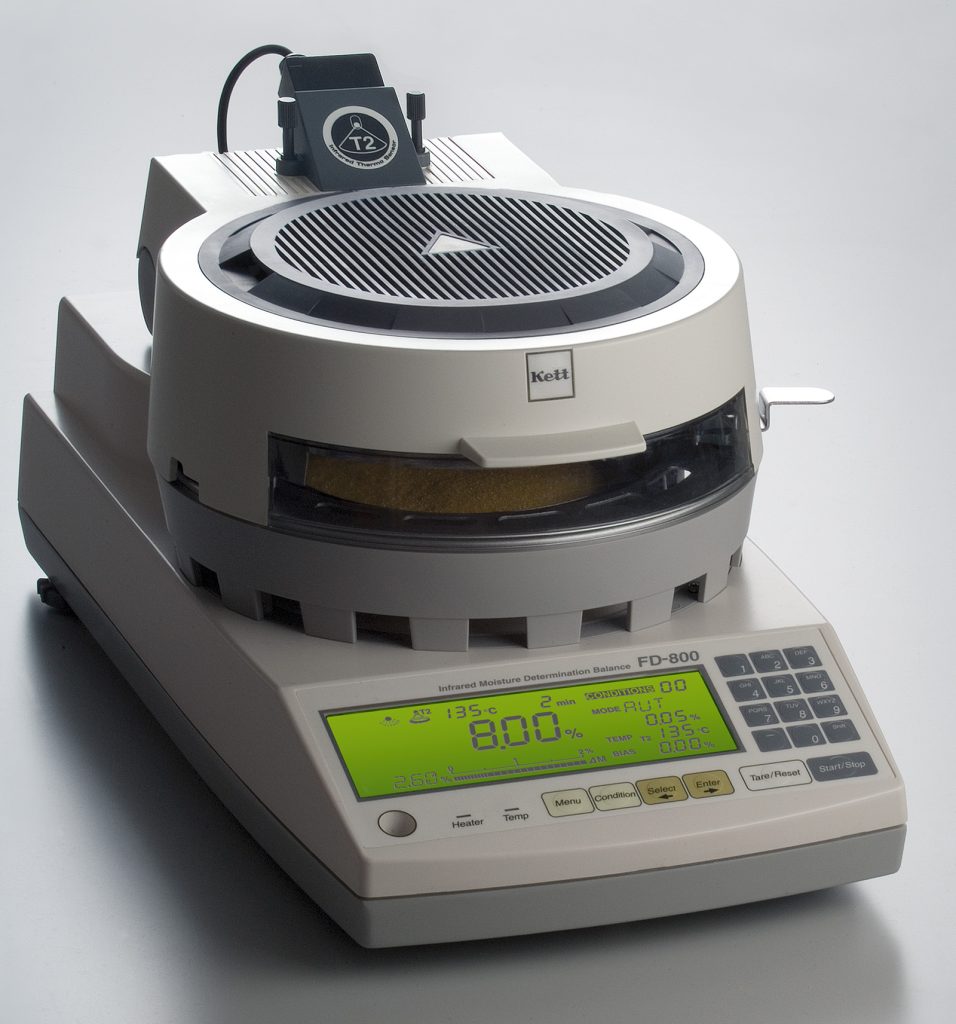
Kett FD800 moisture balance in operation

Moisture Determination Balances

Know the exact moisture content of any liquid or solid sample in minutes — no external calibration required. Kett moisture determination balances use the industry-standard loss-on-drying method, the same primary reference method used to validate all other moisture instruments.

Designed for laboratory, production, and QC environments, every model includes stored drying programs, automatic taring, and our Total Care Warranty covering parts, labor and specification compliance. From entry-level to dual-temperature-control precision, there is a balance for every application and budget.

Key Benefits

Why manufacturers and laboratories choose Kett moisture determination balances for moisture testing.

Instant Measurements

Primary Method Accuracy

No initial calibration required. Loss on drying is the industry-standard reference method — results are directly traceable and accepted without additional validation.

Non-contact, Non-Destructive

Fast Results

Most samples complete in minutes, not hours. Multiple drying programs let you optimize test time for your specific materials, and predictive drying modes on advanced models finish tests even faster.

Multiple Components

Liquids and Solids

Test virtually any liquid, paste, powder, or solid — from raw ingredients to finished products. The large sample pan accommodates heterogeneous materials without requiring sample preparation.

Automatic Taring

Built-in auto-tare zeroes the balance before each test, reducing operator error and keeping results consistent from one test to the next.

Liquids and Solids

Stored Drying Programs

Save drying temperature, time, and mode settings for each sample type. Switch between stored programs instantly — no reconfiguration between different materials or product lines.

Coatweight and Film Thiickness

GLP/GMP Compliant

Built-in calibration verification and data output to printers or PC support full measurement traceability for regulated environments including pharmaceutical, food, and ISO-certified laboratories.

How it Works

Moisture determination balances measure moisture content using the loss-on-drying (LOD) method — the industry-standard primary reference test.

An operator places a liquid or solid sample on the pan and closes the lid. The integrated balance weighs the initial sample, then the heater dries the material while the balance periodically re-weighs it. When drying is complete, the instrument automatically calculates the moisture content (or solids content) based on the weight lost.

Depending on the model, drying can be set for a fixed time, run continuously, or stop automatically when weight loss reaches a stable gradient. Advanced models use predictive algorithms that estimate the final moisture percentage and end the test early once the result meets a preset confidence level — significantly reducing cycle time on routine samples.

All Kett moisture balances allow the operator to check, adjust, and verify calibration on-site without sending the instrument out for service. This eliminates downtime and third-party calibration costs while maintaining full traceability to the LOD reference method.

What You Can Measure

Sample Industries and Applications

Moisture determination balances deliver fast, traceable moisture analysis across manufacturing, laboratory, and research environments.

Food and Grain

Moisture testing for raw materials, in-process samples, and finished goods across grains, dairy, snack foods, and meat products. Results in minutes help production staff adjust processes before product leaves the line.

Pharmaceutical

Pharmaceutical

Incoming material verification, in-process checks, and release testing for active ingredients, excipients, and finished dosage forms. Direct data output supports documentation requirements for regulated manufacturing.

Chemicals

Chemical

Moisture measurement of powders, liquids, and intermediates at receiving, blending, and final QC stages. Excess moisture in chemical products can affect reaction yields, cause caking in powders, and shorten shelf life — catching it at the balance keeps production on spec and reduces costly rework.

Packaging

Plastics and Polymers

Moisture testing of pellets, powders, and resins from raw material intake through final product QC. Even small amounts of residual moisture can cause defects during molding and extrusion — catching problems at the balance is faster and cheaper than catching them on the production line.

Pulp and Paper

Pulp and Paper

Fast moisture measurement of pulp, paper, and wood fiber samples. Results correlate directly to oven-dry reference methods, providing a faster alternative to multi-hour oven tests for process monitoring and quality verification.

Laboratory

Laboratory

As a primary reference method, loss-on-drying results are used to validate and calibrate secondary moisture instruments such as NIR analyzers and capacitance meters. A moisture balance is essential equipment for any lab that maintains its own calibration program.

Manufacturing

Manufacturing

Incoming material inspection, in-process monitoring, and final product QC across any industry where moisture affects product quality, shelf life, or regulatory compliance. Simple operation means production staff can run tests without specialized training.

Agriculture

Agriculture

Reference moisture testing for grains, seeds, and agricultural commodities. Used to verify and calibrate handheld and bulk moisture meters in the field, and as the standard bench method where a full-size drying oven is impractical.

Featured Products

Three models cover applications from routine production testing to high-precision research. Each includes our Total Care warranty, stored drying programs, and direct data output.

FD800 – Dual Control Moisture Determination Balance

The most advanced balance in the lineup. A dual temperature sensor system monitors both the drying chamber (T1) and the sample surface (T2), automatically reducing heat when it detects hot spots. This prevents scorching on difficult materials — sugars, fats, heat-sensitive coatings — that cause inaccurate results on conventional single-sensor balances. The predictive drying mode calculates the final moisture percentage and ends the test early once confidence targets are met, reducing cycle time on routine samples.

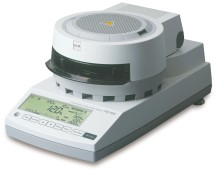
FD720 – Advanced Moisture Balance

Mid-infrared quartz heating elements deliver the same fast startup as halogen but last 5–10 times longer, significantly lowering total cost of ownership. The large 130mm (5″) pan and 120g capacity handle heterogeneous samples without preparation — and let homogeneous samples spread thinner for faster drying.

Six measurement modes, 100-test memory, and direct PC output via RS-232C provide the versatility and traceability that production labs need.

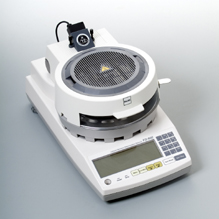
Kett FD660 moisture balance

FD660 Moisture Balance

The lowest total cost of ownership in its class. Organic carbon heating elements are rated at 7,000+ hours — roughly four times longer than comparable infrared lamps — and a temperature-isolating design protects the balance mechanism from heat stress. Simple one-button operation: place the sample, close the lid, press start.

Primary-method accuracy for production environments where uptime and low maintenance costs drive the buying decision.

Primary Method Accuracy — Without the Complexity

Our engineers can help match the right balance to your materials, throughput, and compliance requirements.