
Welcome to Kett - Tomorrow's Testing Today

The Torque Meter That Also Mixes.
Every overhead stirrer with a torque display is estimating from motor current. This one measures. A calibrated strain-gauge transducer sits in the drive path between motor and shaft, reads the actual torque on the blade to three decimals, and sends it out as a 0 to 5 V signal you can log, chart, and hand to another department. The drive is an 80 W Three-One Motor: 0.5 N·m, 20 to 1200 rpm held by feedback control, built for syrups, solutions, and the thin batches that build as they run.
$16,395.00 – $16,995.00Price range: $16,395.00 through $16,995.00

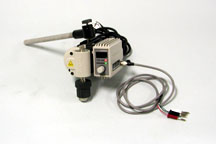
Torque trend displays tell you the batch changed. A transducer tells you by how much. This model carries a purpose-built through-type strain-gauge torque meter between the motor and the mixing shaft, calibrated at the factory and read by a digital amplifier to three decimal places. The through-shaft design suppresses runout and outside disturbance, so the signal is the blade’s torque and nothing else. Choose the 0 to 1.0 or 0 to 2.0 N·m capacity at purchase; add the -Ft option to output speed alongside torque for mixing-power and scale-up calculations. Underneath, an 80 W Three-One Motor holds 20 to 1200 rpm under feedback control with 0.5 N·m available.
Torque is not viscosity. A viscometer applies a known shear rate through a defined geometry; a mixing blade in a vessel does neither, so the same fluid gives a different torque in a different vessel, at a different fill, at a different speed. What measured torque does give you is a reliable relative value: batch A against batch B at the same setup, the moment a reaction finishes, the point an emulsion breaks. For an apparent viscosity in mPa·s, run reference fluids of known viscosity through your own blade, vessel, and speed, plot torque against viscosity, and read unknowns from that curve. Valid for that setup and controlled temperature; not a substitute for a rheometer. No conversion table or software is supplied with the instrument; the curve is yours to build and maintain.
The motor and transducer share a sealed body weighing 3 kg, with a keyless collet chuck and a stop timer programmable from 30 minutes to 24 hours. The digital amplifier sits beside the stand (930 g) and drives any data logger, including the GL260. The TE is a measuring instrument: an annual calibration inspection is recommended to keep readings traceable, and calibration is performed at the manufacturer’s factory in Japan, arranged through Kett. The TE runs on 100 V; a step-down transformer for 120 V supply is required and is quoted with the instrument. Part of the Heidon Three-One Motor line, manufactured by Shinto Scientific and sold and supported in the US by Kett, with every configuration backed by the One-Year Total Care Warranty covering parts, labor, and specification compliance.
Three ways to order. Motor Only is the drive unit alone, ready for the shafts and blades you already run. The P configuration adds the FS7 blade set and a 500 mm stainless steel shaft for a working setup out of the box. The S configuration adds the stand, completing a full mixing station. Transducer capacity (0 to 1.0 or 0 to 2.0 N·m) and the -Ft speed-output option are specified when you order.
Only need the trend? The BLH1200FT High Power Torque Trend Laboratory Mixer outputs converted torque and speed from the same 80 W drive at a fraction of the cost.
Need a logger that is ready the day the mixer arrives? The GL260 Data Logger records measured torque and speed on ten channels and ships configured for the Three-One Motor.
| Measurement Principle | Strain gauge torque measurement |
|---|---|
| Measurement Range | 0–1.0 N·m or 0–2.0 N·m (selected at order) |
| Accuracy | 0.001 N·m |
| Resolution | 0.001 N·m |
| Form Factor | Desktop |
| Sensor Type | Through-shaft strain gauge torque meter |
| Chuck Type | Keyless collet chuck for ø8 mm shafts |
| Motor Type | DC brushless motor, 80 W, Class B insulation (130°C) |
| Mixing Speed Range | 20–1200 rpm |
| Torque | 0.5 N·m |
| Viscosity Range | Medium to low viscosity |
| Display | 4-digit digital speed display with overload indicator; torque indicator in 20% steps; amplifier shows torque to 3 decimal places |
| Features | Feedback speed control, forward/reverse switching, forward/reverse timer, stop timer (0.5–24 hours), free joint |
| Safety Features | Current limiter, thermal protector, safety cover |
| Communications | Analog 0–5 V torque output; speed output with Ft option |
| Power | 100 VAC ±10%, 50/60 Hz |
| Power Consumption | 200 VA (motor), 12 W (amplifier) |
| Dimensions | Main unit 135 mm (W) × 175 mm (D) × 340 mm (H), 360 mm high with safety cover; amplifier 120 mm (W) × 190 mm (D) × 75 mm (H) |
| Weight | Main unit 3.0 kg (6.6 lbs); amplifier 0.93 kg (2.1 lbs) |
| Standard Accessories | Torque amplifier with AC adapter, clamp holder, safety cover, power cord (2 m), operation manual |
| Options | Speed output (Ft option), GL260 data logger, CS support stand, mixing blades and shafts |
| Warranty | One-Year Total Care Warranty covering parts, labor, and specification compliance. Maintenance Agreements available. |
Reviews
There are no reviews yet.