Welcome to Kett - Tomorrow's Testing Today

USD|ENG
HHS 3000s Multi Function Surface Property Analyzer with Camera 3D

Friction & Wear Testers

Heidon Tribogear friction and wear testers measure the forces that determine how surfaces perform — static and dynamic friction, wear resistance, scratch hardness, adhesion strength, and peel resistance. Whether you need to qualify a new coating, evaluate a lubricant, or verify that a finished product meets specification, these desktop instruments deliver repeatable, standards-compliant results.

Built by Shinto Scientific with over 60 years of tribology expertise, the Tribogear line covers everything from simple coefficient-of-friction measurement to advanced 3D wear mode mapping — all from a single product family. Kett provides direct sales, application engineering and technical support for the full Tribogear line.

Key Benefits

Why manufacturers, laboratories, and R&D teams choose Heidon Tribogear friction and wear testers.

Instant Measurements

Comprehensive Surface Testing

Every instrument in the Tribogear line is purpose-built for tribology — not a fixture bolted onto a general-purpose testing machine. From simple coefficient-of-friction measurement to scratch hardness, wear resistance, adhesion, and peel strength, one product family covers the full range of surface property evaluations.

Non-contact, Non-Destructive

Standards-Compliant Results

Tribogear instruments support testing to JIS K7125, JIS P8147, JIS K5600, and ASTM D1894 standards. Interchangeable attachments allow you to switch between test methods on the same instrument, so a single investment covers multiple compliance requirements.

Multiple Components

Interchangeable Test Configurations

A wide selection of jigs and fixtures — ball indenters, flat indenters, scratch test pins, roller jigs, blade holders, pencil holders, steel wool holders, and peel clips — lets you adapt one instrument to dozens of test scenarios. Heated platens, cooling plates, and liquid trays extend testing to elevated temperatures, subzero conditions, and wet or lubricated environments.

Intuitive Touch Panel Operation

Preset stroke speed, stroke length, and stroke count directly from the instrument's touch panel. No complex scripting languages or specialized training required. Operators can begin testing within minutes of setup.

Liquids and Solids

Integrated Data Analysis

The optional TriboSoft software acquires data directly from the instrument, calculates friction coefficients automatically, and overlays graphs for side-by-side comparison. Results export to standard formats for reporting, quality records, and traceability documentation.

Coatweight and Film Thiickness

60+ Years of Tribology Expertise

Built by Shinto Scientific, the Tribogear line draws on more than six decades of friction and wear testing experience and feedback from over 1,000 installations worldwide. Kett provides direct sales, application engineering, and technical support for the full Tribogear line.

How it Works

Tribogear instruments measure the forces acting between two surfaces in contact. In a standard friction and wear test, the operator mounts the sample on a motorized feed table and selects the test parameters — stroke speed, stroke length, and load — from the touch panel. The table drives the sample beneath a stationary probe or indenter at a controlled speed while a precision load converter records the frictional resistance in real time. Because the test fixture remains fixed and only the sample moves, there is no concern about probe alignment shifting during the test — the result is superior accuracy and repeatability across every stroke. Static and dynamic friction coefficients are calculated automatically from the force data.

For scratch and adhesion testing, the sample moves beneath a stationary conical diamond or sapphire test pin. In the most basic configuration, the pin scratches the surface under a fixed load to determine scratch hardness. But the real advantage is continuous-loading mode: as the table advances, the load on the pin increases progressively from zero to a preset maximum in a single pass. The instrument detects the exact point at which the coating fails — cracking, peeling, or delaminating — by a sudden change in frictional resistance. Instead of running dozens of separate tests at individual fixed loads to find the failure threshold, one continuous-loading test maps the entire load range and pinpoints the critical failure point automatically.

For wear evaluation, the table repeats the stroke in reciprocating motion — up to 99 million cycles — while monitoring changes in frictional resistance over time. The transition from mild to severe wear is visible in the data as it develops, allowing engineers to identify exactly when and how a surface begins to break down. Optional TriboSoft software captures all measurements, calculates coefficients per stroke cycle, and generates overlay graphs for comparison between samples or test conditions.

The Tribogear line extends beyond linear reciprocating tests. Rotary turntable instruments perform disk-on-disk and ball-on-disk friction and wear testing for bearing materials, lubricants, and surface treatments — in both horizontal and vertical axis configurations. A vacuum friction and wear tester enables testing in controlled atmospheres down to 10 Pa for aerospace and advanced materials research. Specialized instruments for tactile measurement and strain testing are also available, rounding out a product family that covers virtually every surface property evaluation from production QC to advanced R&D.

What You Can Measure

Sample Industries and Applications

Kett surface property analyzers serve a wide range of industries requiring accurate measurements of very small differences in surface characteristics.

Automotive

Friction and wear testing enters the workflow at nearly every stage of automotive development — from evaluating wiper-to-glass contact and seat belt slip to qualifying dashboard coatings and verifying thermal insulator durability on engine components. Getting surface properties wrong leads to premature component failure, warranty claims, and customer complaints about noise, feel, or appearance. Tribogear instruments give automotive engineers repeatable, standards-compliant data to qualify materials and coatings before they reach the production line.

Pharmaceutical

Coatings and Surface Treatments

Testing happens during coating development, application process validation, and finished-part inspection — evaluating adhesion of plating, durability of protective films, scratch resistance of painted surfaces, and wear life of anti-corrosion treatments. A coating that peels, scratches, or wears prematurely means rework, scrap, and lost customer confidence. Tribogear continuous-loading scratch testers identify the exact failure point of a coating in a single pass, dramatically reducing the time needed to qualify new formulations or processes.

Chemicals

Personal Care & Cosmetics

Product developers test at the formulation stage, evaluating the smooth texture of creams, the spread and absorption of foundations, the slip of conditioners through hair, and the scratch resistance of nail polishes. Subjective sensory panels are expensive and inconsistent — small differences in formulation can go undetected until customers notice. Tribogear instruments convert subjective feel into objective friction and resistance data, making it possible to compare formulations, track batch consistency, and document claims for regulatory submissions.

Packaging

Packaging and Converting

Coefficient-of-friction testing occurs at receiving, in-process, and finished-goods stages — verifying slip properties of plastic films, evaluating label adhesion, and checking seal-peel performance on flexible packaging. Too much friction causes jams on filling lines; too little causes packages to slide off pallets. Tribogear instruments measure both static and kinetic friction to ASTM D1894 and JIS standards, with peel and adhesion testing available on the same platform.

Pulp and Paper

Printing & Paper

Friction testing applies to paper feed systems, rubber rollers, ink adhesion, and print surface durability — anywhere two surfaces contact each other in a printing or converting process. Paper jams caused by incorrect roller friction waste material and downtime; ink that rubs off in handling damages product appearance. Tribogear instruments measure roller-to-paper friction, evaluate ink and coating adhesion, and test surface durability under reciprocating wear.

Laboratory

Laboratory

Research institutions and university programs use Tribogear instruments for tribology coursework, materials development, and advanced studies including 3D wear mode mapping, variable-load friction analysis, and vacuum friction testing for aerospace materials. Dedicated instruments with integrated TriboSoft data analysis simplify experimental setup and data collection compared to building custom test rigs. Models range from basic static friction testers suitable for teaching to advanced variable-load systems.

Manufacturing

Electronics & Instruments

Scratch resistance testing applies to touch panels, display cover glass, lenses, and device housings during product development and incoming inspection. A scratch or coating failure on a consumer device triggers returns, while a failure on an optical component can compromise system performance. Tribogear scratch and wear testers quantify coating durability under controlled, repeatable conditions so engineers can screen materials before committing to production.

Agriculture

Plastics & Polymers

Testing covers the full development cycle — from screening resin formulations and evaluating surface treatments to qualifying molded or extruded parts against customer specifications. Surface defects like scuffing, hazing, or premature wear erode product value and generate rejects. Tribogear instruments evaluate friction, scratch resistance, and wear behavior under controlled loads and speeds, giving plastics engineers the data to optimize formulations and surface finishes.

Featured Products

Popular Heidon Tribogear instruments from Kett. View all products in this category for the full lineup, including rotary testers, vacuum systems, and specialty instruments.

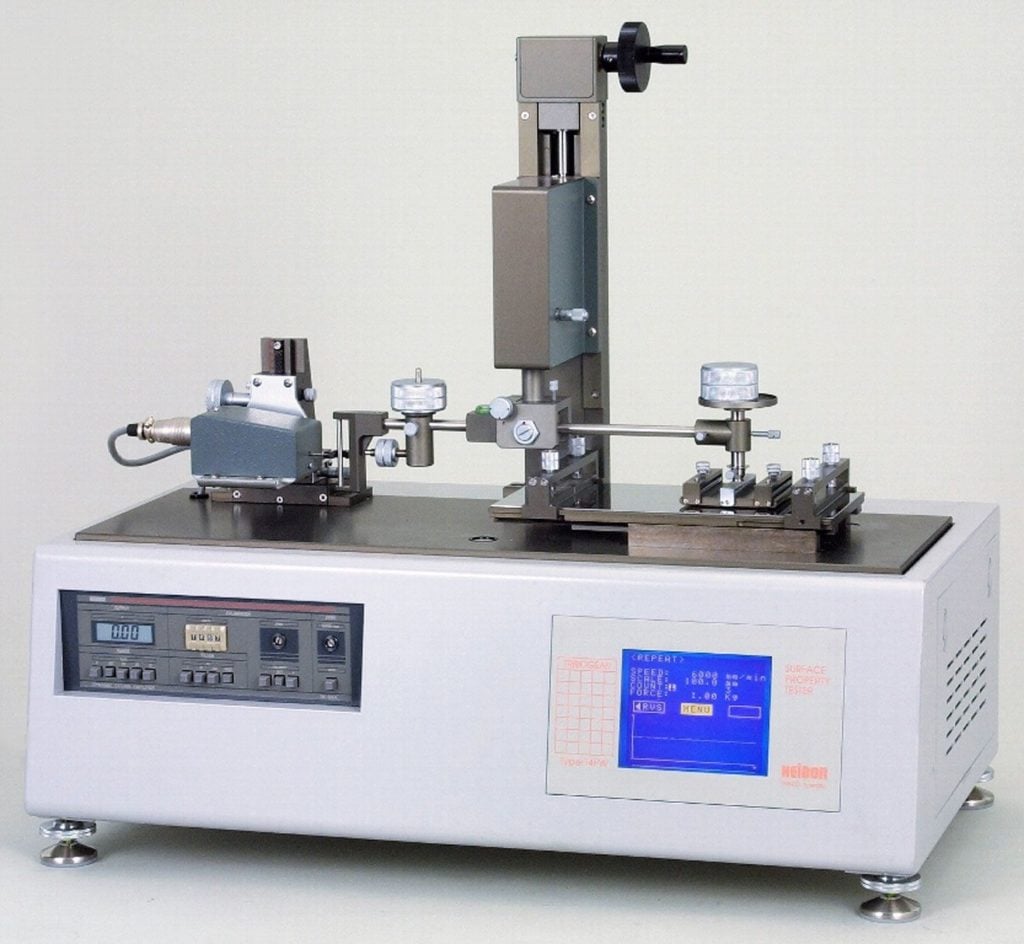
H14FW Multipurpose surface property analyzer

H14FW Multi-Purpose Surface Analyzer

The most versatile instrument in the Tribogear line. A single platform handles friction measurement, wear testing, scratch hardness evaluation, surface stickiness measurement, and peel resistance testing — with JIS K7125, JIS P8147, and JIS K5600 compliance built in.

Interchangeable attachments switch between test methods in minutes, so one investment covers labs that need to run multiple surface evaluations. 

Touch panel operation, a precision AC servo drive from 5 to 6,000 mm/min, and a dual-range load converter (0–0.98 N and 0–19.61 N) make this instrument the natural starting point for any facility building tribology testing capability.

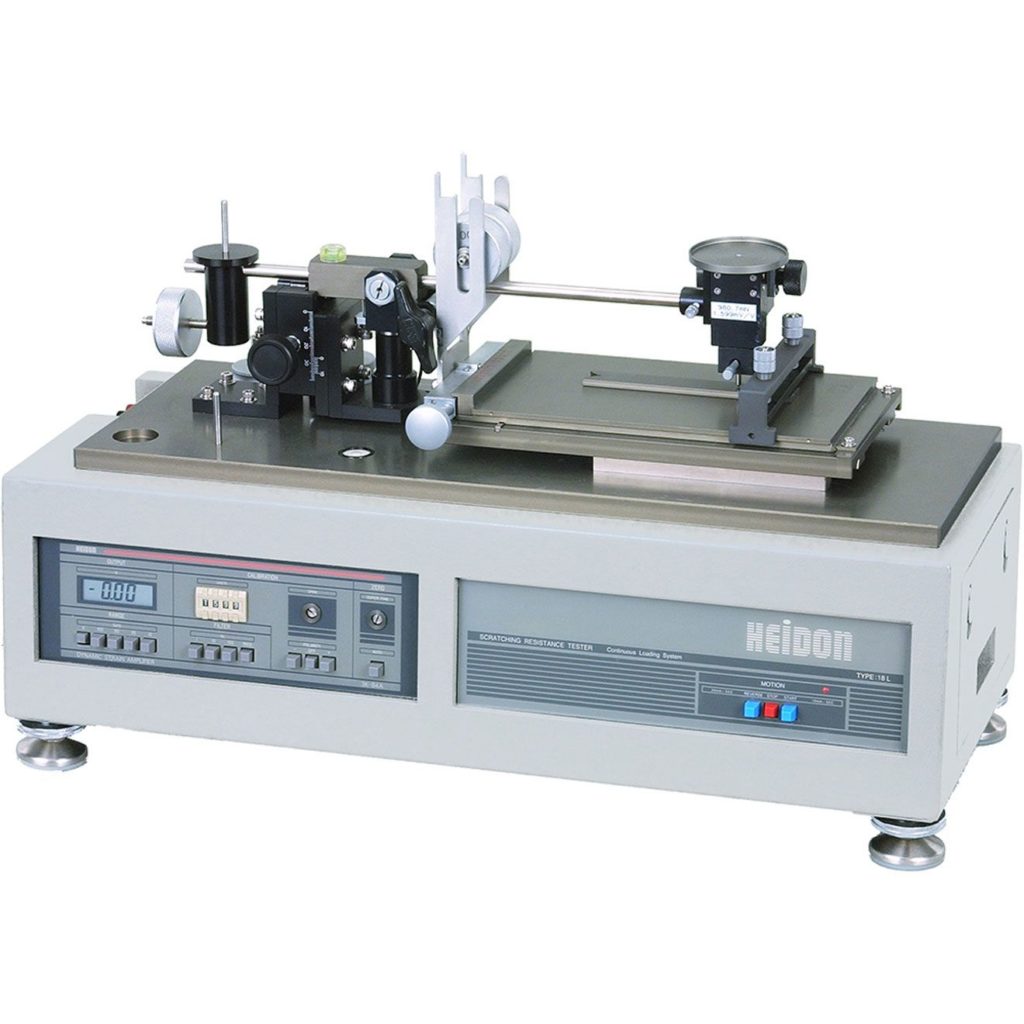
H18L continuous load tester

H18L Scratch Resistance Tester

Answers one question faster than any other method: at what load does this surface fail? A diamond or sapphire test pin moves across the sample under continuously increasing load — from zero to a preset maximum — in a single pass.

The exact failure point is identified automatically by a change in frictional resistance. No need to run dozens of individual fixed-load tests to bracket the failure threshold. The mechanical continuous-loading system requires no calibration, delivering highly reproducible results test after test.

When scratch resistance or coating adhesion is the primary question, this instrument gives you the answer in one stroke.

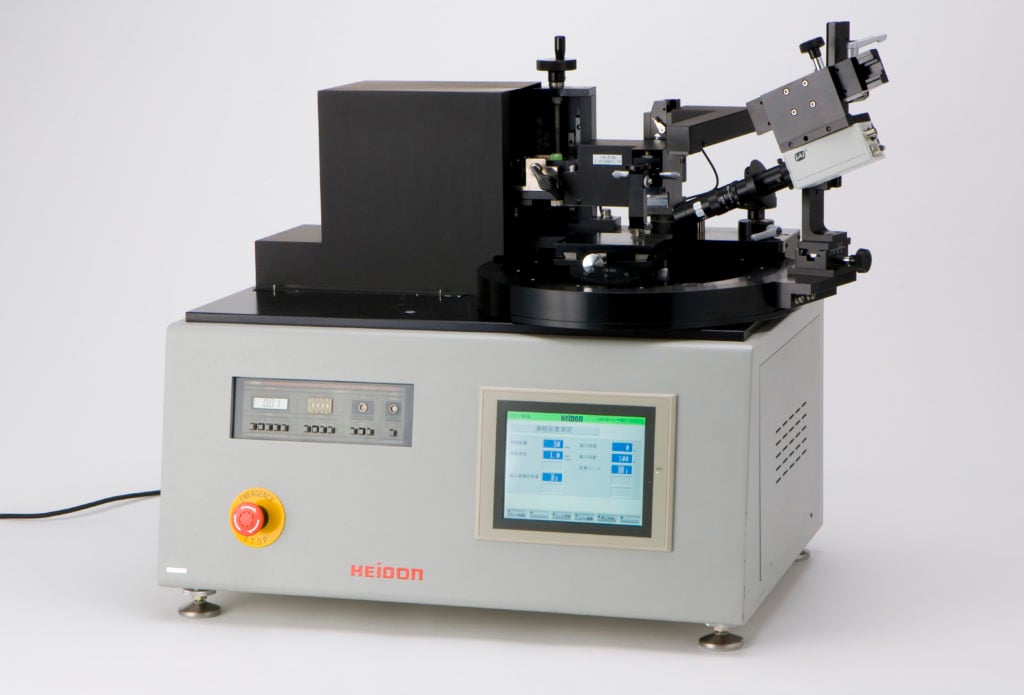
HHS 3000s Multi Function Surface Property Analyzer with Camera 3D

HHS3000 3D Surface Analyzer

Creates a three-dimensional wear mode map — plotting frictional force, number of wear cycles, and vertical load — from a single test on a single sample. This eliminates the conventional approach of testing multiple samples at individual load levels and manually assembling the data.

The STEP operation mode chains up to 30 different measurement sequences into one automated run, combining static friction, dynamic friction, wear, and scratch testing without operator intervention.

With a high-load capacity of 100 to 10,000 g, a precision right-angle crossing balance arm, and full TriboSoft data acquisition, this system is designed for R&D and advanced materials characterization where comprehensive tribological data is required.

Ready to Quantify What You Can Feel?

Our engineers can help you select the right Tribogear instrument for your friction, wear, scratch, or adhesion testing application.